
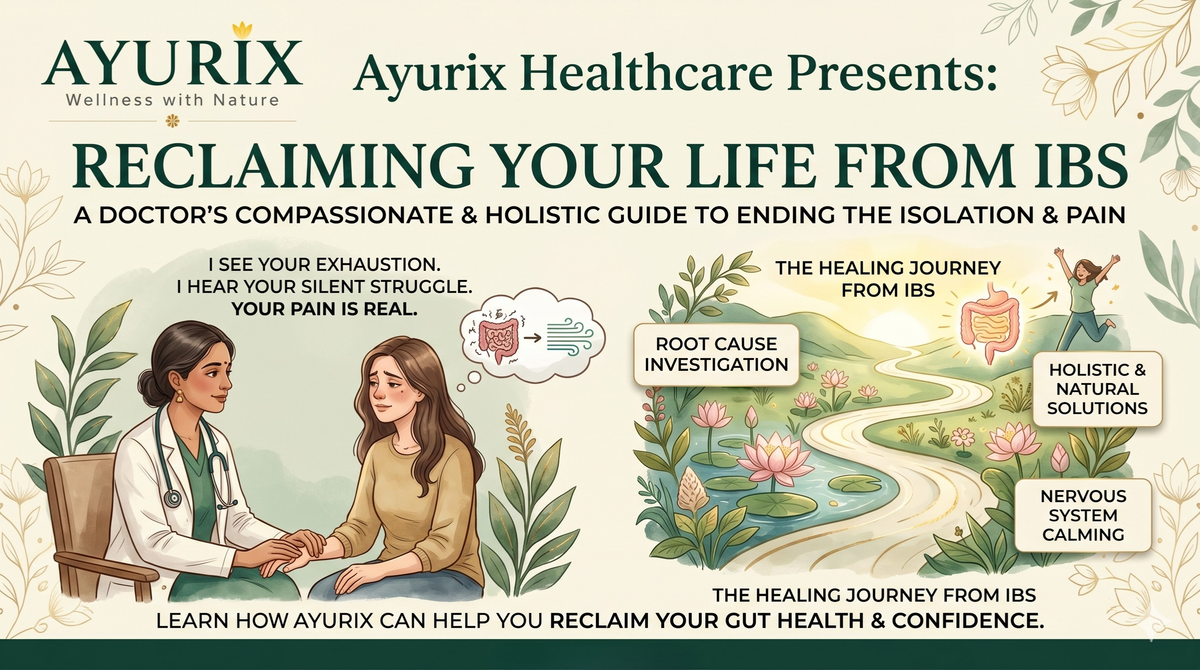
I’ll never forget a patient who came into my office at Ayurix Healthcare last fall. She sat down, clutched her purse to her chest, and burst into tears before I even had the chance to ask how she was doing.
She wasn't crying because she was in physical pain at that exact moment. She was crying from pure, unadulterated exhaustion.
"I just want to eat dinner with my family without my body punishing me for the next three days," she told me. "I feel like I'm going crazy."
That sentence has stuck with me ever since. Because if you are dealing with Irritable Bowel Syndrome (IBS), you already know that it isn't just a digestive issue. It’s a thief. It steals your confidence, your social life, your spontaneity, and your peace of mind.
For too long, I have watched patients come to me completely demoralized because other doctors dismissed them. Because IBS involves bathroom habits, people hide it. They cancel plans, map out the restrooms everywhere they go, and endure years of being told their extreme discomfort is "just stress."
Let me say right now what I tell every single patient who sits in that chair across from my desk: Your pain is real, your frustration is justified, and it is absolutely not all in your head.
The Frustration of "Normal" Test Results
One of the hardest parts of my job is explaining why a patient's test results came back perfectly clear, even though they feel miserable.
Unlike conditions like Crohn's or colitis, IBS doesn't cause visible ulcers or tissue damage. So, you go through the stress of a colonoscopy or a CT scan, and the doctor tells you, "Great news, everything looks normal!" I watch my patients' faces drop when they hear that. You don't want to be sick, but you desperately want an explanation for why you look six months pregnant with bloating by 5:00 PM every day.
But a "normal" scan doesn't mean a functioning gut. In my practice, I explain IBS as a severe communication breakdown.
Your brain and your digestive tract are constantly talking to each other. In a healthy body, the connection is clear. But with IBS, there is severe static on the line. The signals get entirely scrambled. Your brain might tell your gut to rush food through, resulting in a terrifying, sudden need for the bathroom. Or, it might tell your gut to just stop moving entirely, leaving you with heavy, painful constipation.
Finding the Hidden Triggers
When someone comes to Ayurix Healthcare for IBS, I don't just hand them a prescription for an anti-spasmodic pill and send them to the pharmacy. That’s just slapping a band-aid on a bullet wound. We have to figure out why your gut is misfiring in the first place.
I’ve spent years tracking down these triggers with my patients. Usually, it’s a "perfect storm" of a few things:
-
A Wrecked Microbiome: Often, I trace a patient's IBS back to a severe bout of food poisoning years ago, or a heavy round of antibiotics that wiped out their good bacteria, leaving their gut in a state of chronic chaos.
-
Invisible Food Sensitivities: We often find that specific carbohydrates (FODMAPs) are fermenting in the gut instead of digesting. Eating something as simple as garlic or an apple can cause massive gas production and sharp, stabbing pain.
-
A Hypersensitive Nervous System: Some of my patients simply have nerve endings in their gut that are turned up to a volume of 10. A normal amount of digestion—which wouldn't bother me at all—registers as excruciating pain for them.
How We Fix It Together
True to the "Wellness with Nature" philosophy of Ayurix Healthcare, I don't believe in forcing your body into submission. We have to gently coax it back into a rhythm.
When you work with me, we become detectives. We use targeted, short-term dietary protocols to put the fire out quickly. Food should never be your enemy, so the goal is always to get you eating the widest variety of foods possible without fear. We bring in natural, gut-soothing herbs and medical-grade probiotics to rebuild the damage, while using modern diagnostics to ensure we aren't missing anything.
But most importantly, we work on calming your nervous system. I spend a lot of time helping my patients break the vicious cycle of fearing food, which in itself keeps the gut locked in a state of high alert.
A Final Note
Living with IBS often feels like a full-time, unpaid job. I see how much mental energy it takes just to get through a normal workday when your stomach is in knots.
But it truly does not have to be your forever. I have watched patients go from being terrified of leaving their house to traveling, eating out, and simply living their lives again. You deserve to eat a meal without analyzing it first. When you are ready to stop managing your misery and start actually healing, my door is always open.